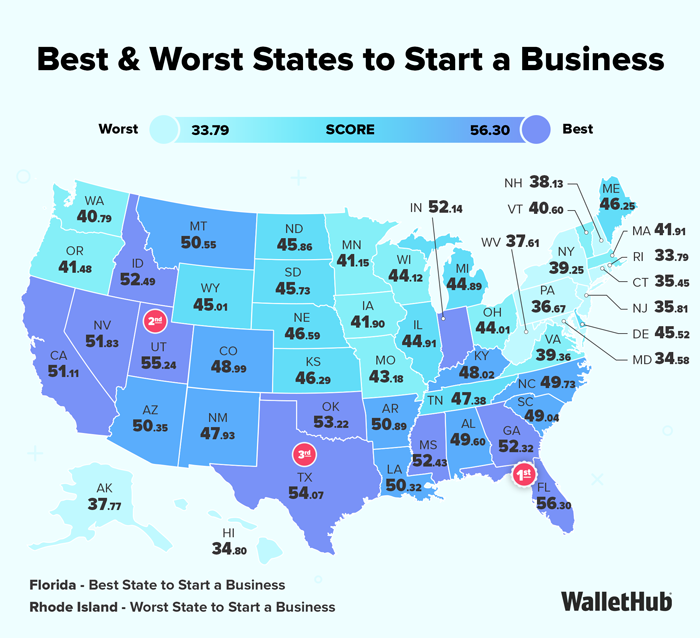
Starting a business is never easy. Over one-fifth of all startups typically don’t survive past year one of operation, according to the U.S. Bureau of Labor Statistics, and nearly half never reach their fifth anniversary. Staying afloat is challenging even in stable times—and even more so amid elevated inflation and persistent labor market tightness.
Beyond these macroeconomic headwinds, there are many other common reasons startups fail, and a “bad location” remains one of the top ones. Choosing the right state for a business is therefore crucial. A state that offers the right ecosystem—access to capital, skilled talent, affordable real estate, for instance—can give new ventures a leg up not just to start, but to scale.
In this study, WalletHub compared the 50 states across 25 key indicators of startup success to determine the most fertile grounds in which to launch and grow an enterprise.

Chip Lupo, WalletHub Analyst
Main Findings
Best States to Start a Business
|
Overall Rank |
State |
Total Score |
Business Environment Rank |
Access to Resources Rank |
Business Costs Rank |
|---|---|---|---|---|---|
| 1 | Florida | 56.30 | 2 | 12 | 27 |
| 2 | Utah | 55.24 | 6 | 2 | 31 |
| 3 | Texas | 54.07 | 1 | 11 | 34 |
| 4 | Oklahoma | 53.22 | 13 | 30 | 2 |
| 5 | Idaho | 52.49 | 17 | 13 | 9 |
| 6 | Mississippi | 52.43 | 20 | 41 | 1 |
| 7 | Georgia | 52.32 | 5 | 32 | 21 |
| 8 | Indiana | 52.14 | 14 | 22 | 8 |
| 9 | Nevada | 51.83 | 7 | 14 | 28 |
| 10 | California | 51.11 | 3 | 1 | 49 |
| 11 | Arkansas | 50.89 | 24 | 27 | 3 |
| 12 | Montana | 50.55 | 10 | 45 | 6 |
| 13 | Arizona | 50.35 | 4 | 28 | 29 |
| 14 | Louisiana | 50.32 | 8 | 33 | 15 |
| 15 | North Carolina | 49.73 | 16 | 29 | 14 |
| 16 | Alabama | 49.60 | 23 | 39 | 5 |
| 17 | South Carolina | 49.04 | 22 | 37 | 10 |
| 18 | Colorado | 48.99 | 12 | 7 | 37 |
| 19 | Kentucky | 48.02 | 36 | 17 | 7 |
| 20 | New Mexico | 47.93 | 18 | 44 | 11 |
| 21 | Tennessee | 47.38 | 9 | 38 | 25 |
| 22 | Nebraska | 46.59 | 27 | 25 | 22 |
| 23 | Kansas | 46.29 | 32 | 21 | 17 |
| 24 | Maine | 46.25 | 15 | 40 | 26 |
| 25 | North Dakota | 45.86 | 21 | 43 | 16 |
| 26 | South Dakota | 45.73 | 34 | 46 | 4 |
| 27 | Delaware | 45.52 | 19 | 10 | 40 |
| 28 | Wyoming | 45.01 | 26 | 42 | 24 |
| 29 | Illinois | 44.91 | 38 | 3 | 35 |
| 30 | Michigan | 44.89 | 40 | 23 | 13 |
| 31 | Wisconsin | 44.12 | 45 | 15 | 23 |
| 32 | Ohio | 44.01 | 33 | 36 | 19 |
| 33 | Missouri | 43.18 | 39 | 31 | 20 |
| 34 | Massachusetts | 41.91 | 28 | 6 | 44 |
| 35 | Iowa | 41.90 | 49 | 26 | 12 |
| 36 | Oregon | 41.48 | 25 | 20 | 41 |
| 37 | Minnesota | 41.15 | 48 | 9 | 32 |
| 38 | Washington | 40.79 | 42 | 4 | 43 |
| 39 | Vermont | 40.60 | 43 | 24 | 30 |
| 40 | Virginia | 39.36 | 30 | 35 | 39 |
| 41 | New York | 39.25 | 37 | 5 | 48 |
| 42 | New Hampshire | 38.13 | 29 | 49 | 33 |
| 43 | Alaska | 37.77 | 11 | 47 | 46 |
| 44 | West Virginia | 37.61 | 46 | 50 | 18 |
| 45 | Pennsylvania | 36.67 | 47 | 34 | 36 |
| 46 | New Jersey | 35.81 | 35 | 8 | 50 |
| 47 | Connecticut | 35.45 | 41 | 16 | 45 |
| 48 | Hawaii | 34.80 | 31 | 48 | 42 |
| 49 | Maryland | 34.58 | 44 | 18 | 47 |
| 50 | Rhode Island | 33.79 | 50 | 19 | 38 |
Note: With the exception of “Total Score,” all of the columns in the table above depict the relative rank of that state, where a rank of 1 represents the best conditions for that metric category.

- Highest
- 1. Idaho
- 2. Utah
- 3. Delaware
- 4. Nevada
- 5. Florida
- Lowest
- 46. Hawaii
- 47. Connecticut
- 48. New York
- 49. Vermont
- 50. West Virginia

- Most
- T-1. North Dakota
- T-1. Utah
- T-1. South Dakota
- T-1. Iowa
- T-1. Nebraska
- Least
- 46. Rhode Island
- 47. California
- 48. Florida
- 49. Delaware
- 50. Arizona

- Lowest
- 1. Mississippi
- 2. West Virginia
- 3. Arkansas
- 4. Louisiana
- 5. Alabama
- Highest
- 46. California
- 47. Hawaii
- 48. New Jersey
- 49. Massachusetts
- 50. Maryland

- Highest
- 1. California
- 2. Nevada
- 3. Illinois
- 4. Washington
- 5. Kentucky
- Lowest
- 46. Virginia
- 47. South Dakota
- 48. North Dakota
- 49. New Hampshire
- 50. Vermont

- Longest
- 1. Alaska
- 2. Texas
- T-3. Louisiana
- T-3. Wyoming
- T-5. Mississippi
- T-5. North Dakota
- Shortest
- T-43. Massachusetts
- T-43. New York
- T-47. Oregon
- T-47. Rhode Island
- 49. Vermont
- 50. Utah

- Cheapest
- 1. Iowa
- 2. Maine
- 3. South Dakota
- 4. Montana
- 5. Minnesota
- Most Expensive
- 45. New Jersey
- 46. Maryland
- T-47. California
- T-47. Alaska
- T-47. New York

- Most
- 1. Massachusetts
- 2. Colorado
- 3. New Jersey
- 4. Maryland
- 5. Vermont
- Least
- 46. Kentucky
- 47. Louisiana
- 48. Arkansas
- 49. Mississippi
- 50. West Virginia
In-Depth Look at the Best States to Start a Business
Florida
Florida is the best state for starting a business in 2026, boasting the third-most startups per capita and the highest percentage of adults who engage in entrepreneurship. The number of small businesses in the state grew by nearly 16% between 2017 and 2023, the fifth-highest percentage in the country.
There are plenty of good reasons why so many people start businesses in Florida, including the fact that it has the 15th-lowest corporate taxes.
Given the prevalence of retirees in Florida, you might assume the labor force is dwindling, but the opposite is true. In fact, the working-age population (age 16-64) is growing faster in Florida than in all but five other states. Plus, Florida has the third-highest percentage of workers who say they are enthusiastic about and committed to their work.
Utah
Utah is the second-best state for starting a business, in large part because it’s the second-easiest state for securing financing for business loans, and it has the fifth-largest year-over-year employment growth in the country, at over 3%. Having the necessary capital makes it much easier for a business to get off the ground, and a strong job growth rate indicates that existing businesses are doing well. Business owners in Utah also save money on employee benefits, as the average health insurance premium per enrolled employee ranks 22nd, placing it among the top half of states with the lowest premiums.
In addition, Utah was recognized as one of the best states on the “Digital States Survey” from the Center for Digital Government, which measures how well states are using technology to improve the efficiency of their businesses. Tech-savvy Utahans should be able to capitalize on their skillset and access to good technology to help their businesses thrive.
Texas
The third-best state for starting a business is Texas, which has the 10th-highest entrepreneurship rate in the country. There’s great potential, too, as the state has the 11th-highest share of fast-growing firms.
Texas also has the ninth-highest share of businesses that are in “strong clusters,” at over 53%. Clusters are interconnected businesses that specialize in the same field, and “strong clusters” are ones that are in the top 25% of all regions for their particular specialization. If businesses fit into one of these clusters, they will have an easier time getting the materials they need, and can tap into an existing customer base. To some degree, it might mean more competition, though.
Business owners in Texas benefit from favorable conditions, as the state has the third-highest growth in working-age population and the third-highest employment growth in the country, too. On top of that, workers in Texas are the third most engaged in the nation.
Ask the Experts
National and state economic policies can greatly affect business creation and the direction they take after launching. For insight into the ways in which different measures impact business, we asked a panel of experts to address the following key questions:
- Do you believe that our current economic policies promote new business development?
- To what extent do state policies, such as corporate tax rates, influence decisions about whether and where to start a new business?
- Are tax breaks and other incentives to encourage new businesses on net a good or bad investment for states?
- Which, in your opinion, are the best industries for starting a business in 2026, and what states are most likely to see an increase in start-ups activity?
- What measures can state authorities undertake in order to encourage entrepreneurs to start new businesses in their state?
Ask the Experts

Yong Li – Lee Professor of Entrepreneurship and Research Director of Troesh Center for Entrepreneurship and Innovation, Ashley Roderick - MBA candidate, Lee Business School, Oliver Ye - Ph.D. candidate, William F. Harrah College of Hospitality, University of Nevada, Las Vegas
Read More

MBA Class of 1973 Senior Lecturer of Business Administration - Harvard Business School
Read More

Senior Lecturer, Management and Human Resources - Wisconsin School of Business - University of Wisconsin–Madison
Read More

Associate Director, Center for Entrepreneurship, Innovation, and Franchising Management, Professor, College of Business Administration - University of Nebraska at Omaha
Read More

Manager of Operations, John P. Lowth Entrepreneurship Center – The University of Tampa
Read More

Ph.D. – Associate Professor, Department of Management and Marketing, College of Business – Texas A&M University - San Antonio
Read More
Methodology
In order to determine the best and worst states to start a business, WalletHub compared the 50 states across three key dimensions: 1) Business Environment, 2) Access to Resources and 3) Business Costs.
We evaluated those dimensions using 25 relevant metrics, which are listed below with their corresponding weights. Each metric was graded on a 100-point scale, with a score of 100 representing the most favorable conditions for new-business creation.
Finally, we determined each state’s weighted average across all metrics to calculate its overall score and used the resulting scores to rank-order our sample.
Business Environment – Total Points: 50
- Average Length of Work Week (in Hours): Double Weight (~5.88 Points)
- Share of Engaged Workers: Double Weight (~5.88 Points)
Note: This metric is based on Gallup’s “State of the American Workplace” report. Gallup defines engaged employees as those who are involved in, enthusiastic about and committed to their work and workplace. - Growth in Number of Small Businesses: Full Weight (~2.94 Points)
- Startups per Capita: Full Weight (~2.94 Points)
- Growth of Average Business Revenues: Double Weight (~5.88 Points)
- Five-Year Business Survival Rate: Full Weight (~2.94 Points)
- Industry Variety: Full Weight (~2.94 Points)
- Industry-Cluster Strength: Full Weight (~2.94 Points)
Note: This metric is based on data from the U.S. Cluster Mapping Project. “Industry-Cluster Strength” refers to the level of high employment specialization of a cluster, which is defined by the U.S. Cluster Mapping Project as a “regional concentration of related industries in a particular location.” - Entrepreneurship Index: Double Weight (~5.88 Points)
- Share of Fast-Growing Firms: Full Weight (~2.94 Points)
Note: This metric measures the number of firms in each state that are included on the “Technology Fast 500” list (Deloitte report) as a share of total firms in each state. - “Digital States” Survey Grade: Full Weight (~2.94 Points)
- Job Growth (2024 vs. 2020): Full Weight (~2.94 Points)
- GDP Growth (2024 vs. 2023): Full Weight (~2.94 Points)
Access to Resources – Total Points: 25
- Financing Accessibility: Full Weight (~3.57 Points)
Note: This metric was calculated as follows: Total Annual Value of Small-Business Loans / Total Number of Small Businesses. - Venture Investment Amount per Capita: Full Weight (~3.57 Points)
- Human-Capital Availability: Double Weight (~7.14 Points)
Note: This metric was calculated as follows: Number of Job Openings per Number of Civilians in Labor Force – Unemployment Rate. - Higher-Education Assets: Full Weight (~3.57 Points)
Note: This is based on WalletHub’s “Best Universities Ranking” report. - Share of College-Educated Population: Full Weight (~3.57 Points)
Note: This metric measures the share of the population aged 25 and older with a bachelor’s degree or higher. - Working-Age Population Growth: Full Weight (~3.57 Points)
Note: “Working-Age Population” includes individuals aged 16 to 64.
Business Costs – Total Points: 25
- Office-Space Affordability: Double Weight (~6.25 Points)
Note: This metric measures the per-square-foot cost of commercial office space. - Labor Costs: Double Weight (~6.25 Points)
Note: This metric measures the median annual income of the state. - Average Annual Single Insurance Premium per Enrolled Employee: Full Weight (~3.13 Points)
Note: This metric refers to employer-based health insurance. - Corporate Taxes: Full Weight (~3.13 Points)
- Total Effective State & Local Tax Rates on Mature Corporate Headquarters: Full Weight (~3.13 Points)
- Cost of Living: Full Weight (~3.13 Points)
Sources: Data used to create this ranking were collected as of December 19, 2025 from the U.S. Census Bureau, Bureau of Labor Statistics, Ewing Marion Kauffman Foundation, Center for Digital Government, National Venture Capital Association, Indeed.com, Tax Foundation, U.S. Cluster Mapping Project, Deloitte, Gallup, U.S. Bureau of Economic Analysis, Council for Community and Economic Research, LoopNet, Federal Deposit Insurance Corporation, Kaiser Family Foundation and WalletHub research.

WalletHub experts are widely quoted. Contact our media team to schedule an interview.